This was my entry for the AI Battlesnake competition in 2017. Battlesnake is an AI competition where snakes move around an arena looking for food and trying to avoid collisions with walls, other snakes, and themselves. Last one slithering wins!
I decided to try genetic programming instead of neural nets. For a good reference, see A Field Guide to Genetic Programming.
My evolved snakes did well in competition, and I loved seeing them evolve original and surprising behaviour that I wouldn’t have programmed myself.
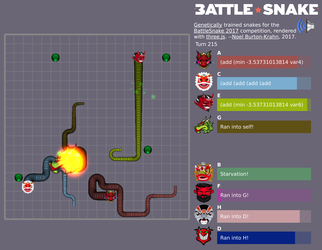
The training loop looked like this:
- Start with a population of random “genomes”.
- Play them off against each other.
- Select the fittest.
- Breed a new generation by randomly mixing the fittest genomes with some mutations.
- Repeat.
Interesting Observations
- Snakes learned original behaviour that I would not have predicted or thought to code for.
- My biggest problem with the genetic algorithm was inbreeding. When a winner genome appeared it would repeat and fill the whole population, so I needed to keep some losers and mutants around to keep the gene pool diverse.
- They evolved too cooperatively! When I trained them all together they learned to share food with each other and were not competitive enough. I had to keep some hard-coded greedy predators in each generation so they always had something to compete with.
Technical Details
Combining Parent Expressions
Each snake’s “genome” is a mathematical expression that takes a set of senses as input and outputs a direction to move at each step.
To breed a new genome, swap random subtrees from each parent and add some mutation.
flowchart TB
    classDef chosen fill:#f6d365,stroke:#8a5a00,stroke-width:3px,color:#111;
    classDef swapped fill:#c3bef0,stroke:#4c3f91,stroke-width:3px,color:#111;

    subgraph crossover [Subtree crossover]
        direction TB
        subgraph parentA [Parent A]
            direction TB
            pa0["if_neg"]
            pa1["enemyDist"]
            pa2["add"]
            pa3["foodDist"]
            pa4["space"]
            pa0 --> pa1
            pa0 --> pa2
            pa2 --> pa3
            pa2 --> pa4
        end

        subgraph parentB [Parent B]
            direction TB
            pb0["if_neg"]
            pb1["neg"]
            pb2["turnRight"]
            pb3["enemyDist"]
            pb0 --> pb1
            pb0 --> pb2
            pb1 --> pb3
        end

        swap["swap highlighted subtrees"]

        subgraph children [Children]
            direction LR
            subgraph childA [Child A]
                direction TB
                ca0["if_neg"]
                ca1["enemyDist"]
                ca2["neg"]
                ca3["enemyDist"]
                ca0 --> ca1
                ca0 --> ca2
                ca2 --> ca3
            end

            subgraph childB [Child B]
                direction TB
                cb0["if_neg"]
                cb1["add"]
                cb2["turnRight"]
                cb3["foodDist"]
                cb4["space"]
                cb0 --> cb1
                cb0 --> cb2
                cb1 --> cb3
                cb1 --> cb4
            end
        end
    end

    class pa2,pa3,pa4 chosen
    class pb1,pb3 chosen
    class ca2,ca3 swapped
    class cb1,cb3,cb4 swapped

    pa2 -.-> swap
    pb1 -.-> swap
    swap -.-> ca2
    swap -.-> cb1
Sense Maps
The inputs to the genome expression are a set of “senses” I called smell maps. For example, the shortest distance to food or other snakes. Starting from every food cell or enemy cell, the code runs a breadth-first flood fill and stores the number of moves to the nearest source. Close food is good, and cells with enemy distance less than or equal to 1 are heavily penalized.
Enemy distance map:
4 3 2 3 4
3 2 1 2 3
2 1 E 1 2
3 2 1 2 3
4 3 2 3 4
Food distance map:
2 1 2 3 4
1 F 1 2 3
2 1 2 3 4
3 2 3 4 5
4 3 4 5 6
Conclusion
The core technique of genetic programming is defining a genome and the splicing reproduction function. The art is in managing the mutation rate, avoiding inbreeding, and maintaining a challenging environment to evolve in.
Update 2026
Next I would like to try these ideas against some modern reinforcement learning techniques. Maybe use genetic algorithms to help build or tune the RL neural network pipeline.